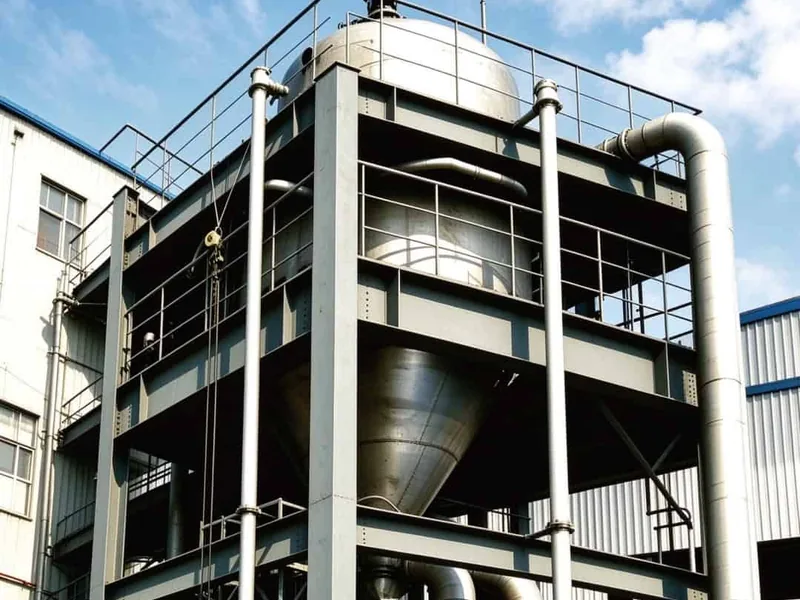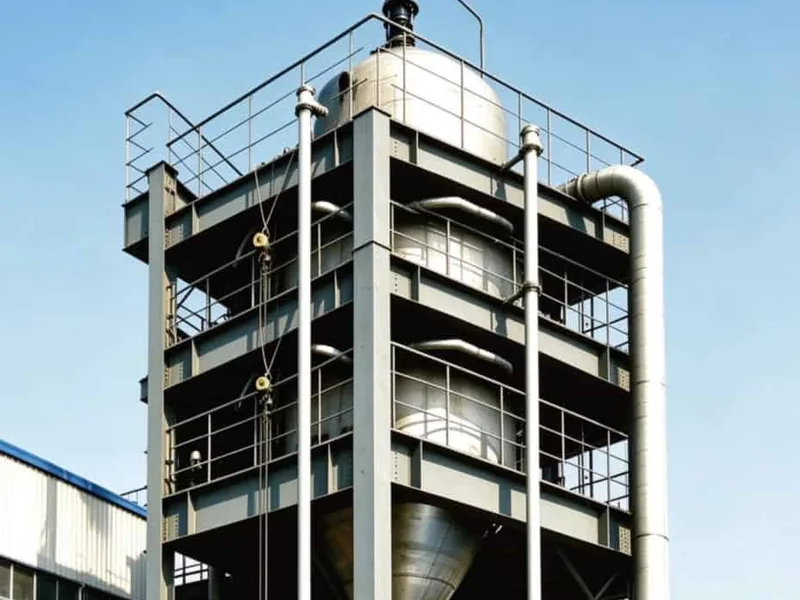
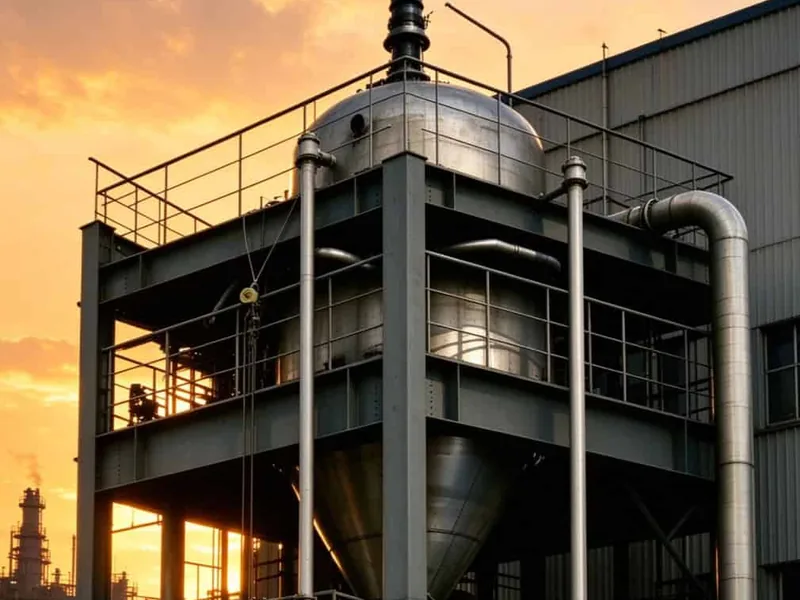
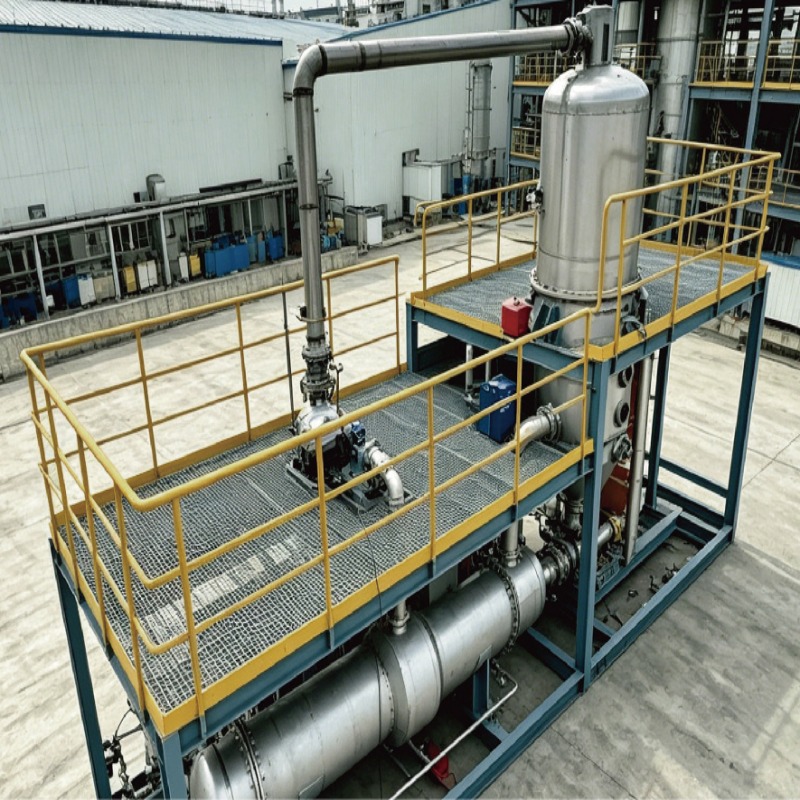
Lowering the pressure lowers the boiling point, and that single relationship protects products that cannot take heat. A Vacuum Evaporation Process concentrates juices, extracts, pharmaceutical intermediates and high-boiling-point brines at temperatures well below their atmospheric boiling point. Center Enamel designs these systems around the product’s tolerance rather than around the utility’s convenience.
Why Vacuum Lowers the Boiling Point
At atmospheric pressure water boils at one hundred degrees Celsius. Reduce the pressure above the liquid and the boiling temperature falls with it, so at a moderate vacuum water boils near sixty degrees and at a deeper vacuum near forty. Every degree removed from the boiling point is a degree of thermal exposure the product never sees. The same relationship allows solutions with a very high boiling point at atmospheric pressure to be evaporated at temperatures a standard heating medium can supply, which is why vacuum is used for sugar syrups, glycerine, glycols and concentrated brines as well as for delicate biological products.
Vacuum System Architecture
A vacuum evaporator combines a boiling body, a heating surface, a condenser and a vacuum source. Falling film bodies with short residence time are usual for heat-sensitive duty, while forced circulation or wiped film designs handle viscous and high-solids streams. The condenser is sized for the vapor load at the lowest expected pressure, and the vacuum source may be a liquid ring pump, a dry pump or a multi stage ejector, chosen by the depth of vacuum required and the cost of the motive steam. Instrumentation is selected for absolute pressure measurement, since gauge readings lose meaning at these levels, and both the body and the condenser are rated for the deepest vacuum the process can reach.
Protecting Heat-Sensitive Products
Temperature is only one of the variables that damage a delicate product; time and surface condition matter as much. Falling film and wiped film bodies keep the liquor in contact with the heating surface for seconds rather than minutes, and the evaporation happens at the free surface of a thin film where the temperature is lowest. Jacket temperatures are set close above the boiling point so the wall never overheats, and the concentrate is cooled promptly after it leaves the last effect. Gentle degassing during heat-up removes dissolved oxygen, and a clean-in-place sequence keeps the surface free of deposits that would raise the required wall temperature. Where the product is a pharmaceutical intermediate, the same body can be supplied with a validated cleaning record.
Concentrating High-Boiling-Point Solutions
Syrups, polyols, glycol streams and saturated brines resist evaporation at atmospheric pressure because their boiling points sit above what low grade steam can deliver. Under vacuum their boiling temperatures come within reach of hot water or low temperature steam, which allows concentration without a high temperature heating medium. Viscosity rises as these liquids concentrate, so the body is designed with larger surface, slower circulation and a discharge arrangement that handles a thick product. Center Enamel models viscosity against concentration for each product and sizes the pump and the surface accordingly.
Solvent Recovery and Condensate Handling
Many vacuum duties evaporate a solvent rather than water, and the condensate becomes a raw material again. A staged condenser separates the solvent from the water vapor, and a receiver collects each cut for return to the process or for sale. Because the condenser runs cold, its cooling water demand is significant, and Center Enamel balances the condenser duty against the vacuum source so that neither is oversized. Where the solvent has value, the recovery ratio is stated as part of the guarantee and verified at commissioning with the plant’s own meter. Receiver sizing follows the batch pattern of the plant, so a campaign run does not overflow a tank that was sized for a steady flow.
Control and Vacuum Stability
Vacuum is the controlling variable, so the loop that holds it is the most important one in the system. Pressure transmitters on the body and the condenser feed a controller that modulates the vacuum source and the vapor valve together, keeping the boiling temperature within a narrow band. Feed flow follows the level in the body, and the heating medium follows the difference between wall and boiling temperature. A controlled shutdown sequence breaks the vacuum slowly, so the product is not boiled violently or drawn into the condenser at the end of a run.
Materials and Fabrication
Vacuum service changes material behaviour, and food or pharmaceutical duty adds cleanability to the requirement. 316L stainless steel with a fine internal finish covers most products, duplex grades serve chloride bearing brines, and glass lined or alloy bodies are used for acidic streams. All internal surfaces are fully drainable and weld dressed where the product can collect. Center Enamel fabricates to ASME, ISO 9001 and EN 13445 practice in a 150,000 square meter facility, pressure and leak tests each body, and delivers the skid with certificates, drawings and a validated cleaning procedure.
Energy and Utility Balance
Vacuum evaporation is not only a quality decision; it also changes the energy picture. A lower boiling point reduces the temperature lift, so less heating medium is needed and low grade waste heat becomes usable. At the same time the condenser and the vacuum source consume cooling water and power, and the balance between them decides the running cost. Center Enamel evaluates mechanical recompression, multiple effects and ejector systems at the same vacuum level, and recommends the combination that keeps the product cool at the lowest total utility cost.
Choosing a Vacuum Evaporation Partner
The right system keeps the product inside its temperature and residence limits while still meeting the evaporation rate. Center Enamel confirms those limits with laboratory trials on the actual liquor, then designs the body, condenser and vacuum source as one package so no component is sized in isolation. Installation, commissioning and operator training are handled by the same engineers, and service support continues afterwards. Vacuum system options and project references are available at cecvessels.com, and sample testing can be arranged before a specification is written.