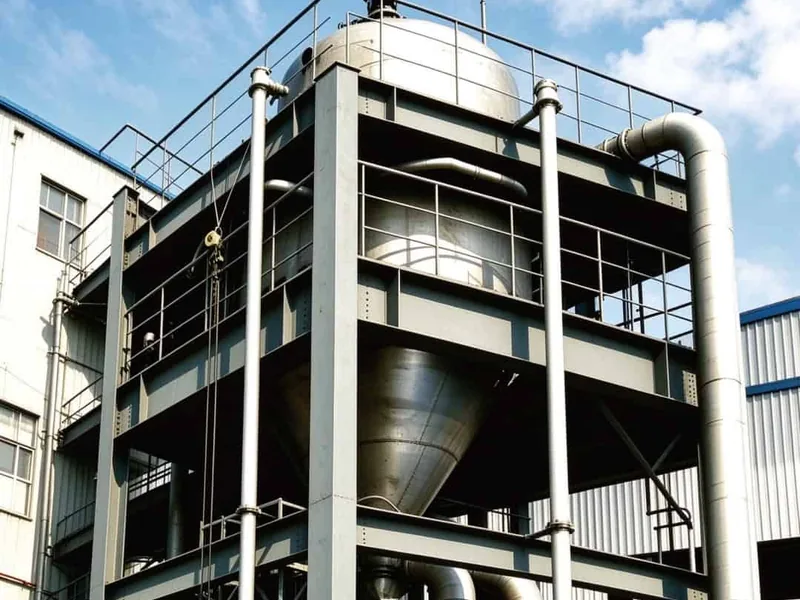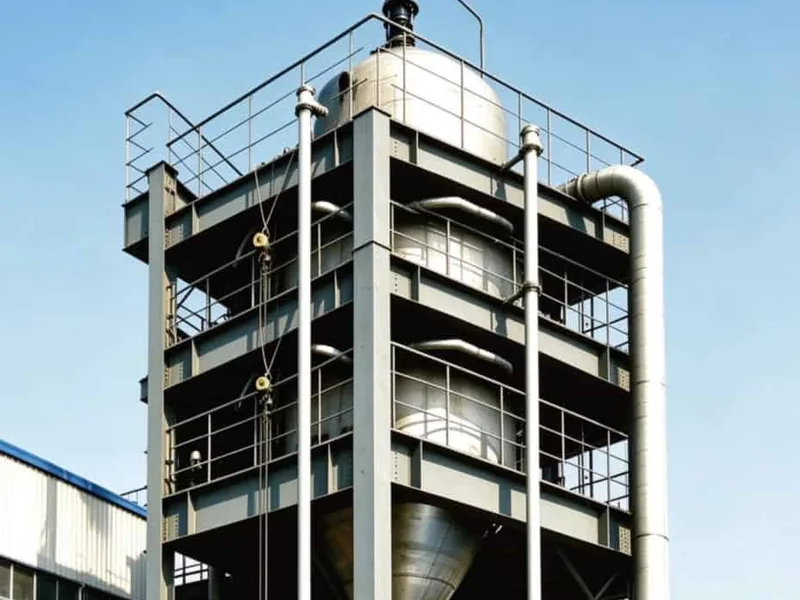
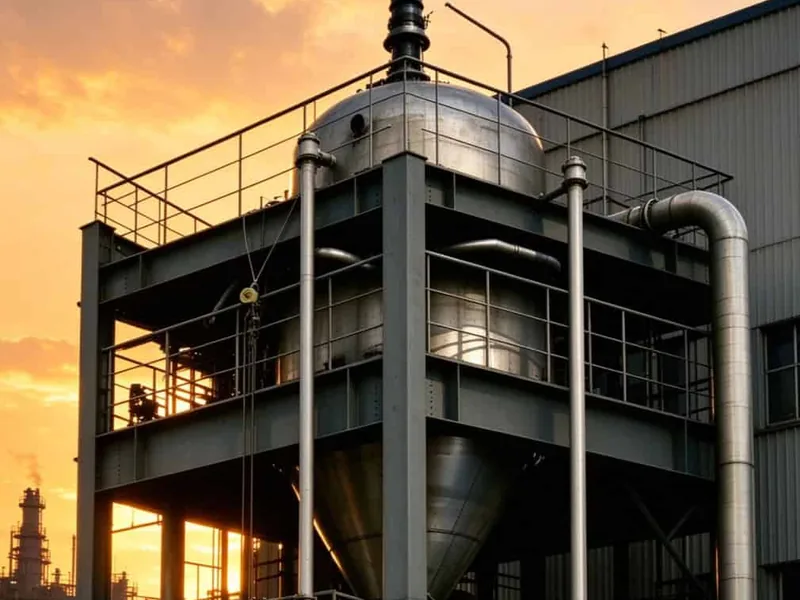
Continuous evaporation concentrates a dilute process stream into a handleable product while removing solvent as vapour. In chemical, food, pharmaceutical and wastewater duties, the evaporator sits on the critical path between upstream reaction and downstream crystallisation or drying. Center Enamel builds Industrial Evaporator System packages that deliver steady concentration, predictable steam economy and straightforward operation.
Principles of Continuous Evaporation
In a continuous system, feed enters at a controlled rate, solvent boils off under a defined temperature and pressure, and concentrated product discharges continuously. Heat is supplied through a steam-heated calandria, a plate pack or a falling film bundle, and the vapour is condensed or routed to the next effect. Because the inventory stays constant, product concentration varies little once the unit reaches steady state.
The key design values are the evaporation rate, the boiling-point elevation of the solution, the allowable product temperature and the available utility conditions. An Industrial Evaporator System sized from those four numbers behaves predictably at start-up and through turndown. Where the product is thermally sensitive, the design shifts towards lower temperature and shorter residence time rather than simply enlarging the heating surface.
Feed pretreatment belongs in the same design conversation. Degassing, filtration and pH adjustment upstream keep the heating surface clean and preserve the coefficient the thermal design assumes. A package specified without that review often loses capacity within the first year, so Center Enamel reviews the upstream conditions as part of the duty definition.
System Configuration and Components
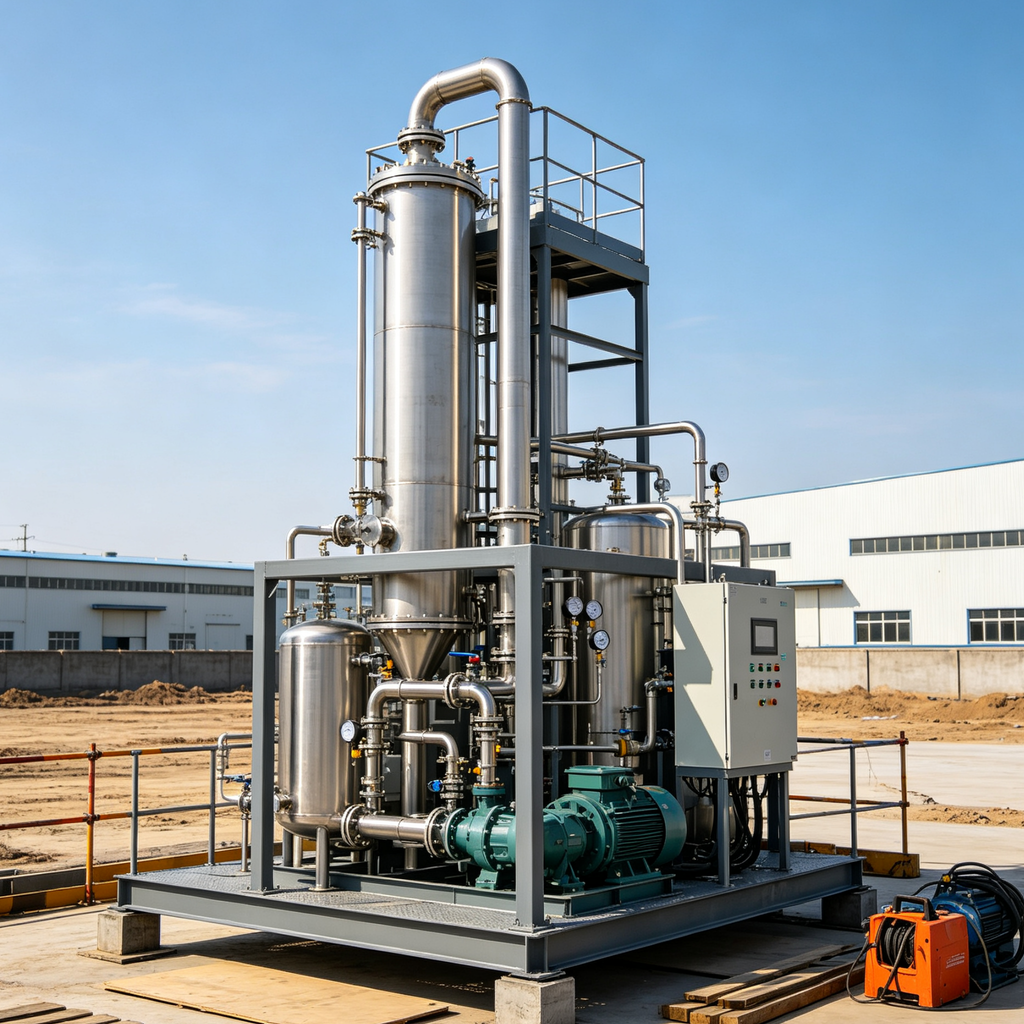
A complete package includes the evaporator body, vapour separator, condenser, vacuum equipment, feed and transfer pumps, and the interconnecting piping skid. Preheating the feed against hot condensate or against the product discharge recovers sensible heat and reduces the load on the main heating surface. Instrumentation covers level, density, temperature and vacuum, with a control scheme that links feed rate to product concentration.
Center Enamel assembles these components on structural skids with tagged piping and pre-tested electrical connections, which compresses site work considerably. The Industrial Evaporator System arrives as a matched set, so pump curves, nozzle sizes and instrument ranges all align with the process design instead of being reconciled on site.
Heat Transfer and Energy Efficiency
Steam economy is the central measure of evaporator performance. A single-effect unit uses roughly one kilogram of steam per kilogram of water evaporated; adding effects, thermal vapour recompression or mechanical recompression reduces that ratio substantially. The right choice depends on utility cost, electricity price and the temperature lift the product allows.
Heat transfer surfaces are designed with margin for fouling and for the viscosity rise that accompanies concentration. Falling film bundles, forced circulation loops and plate packs each suit a different combination of viscosity, solids content and cleaning requirement. Center Enamel evaluates those factors before selecting the arrangement, so the delivered Industrial Evaporator System meets its steam target rather than merely its capacity target.
Control Strategy and Product Consistency
Continuous concentration is held by three linked loops: feed flow, heating medium flow and product density. Density measurement at the discharge drives the feed or transfer rate, while vacuum control stabilises the boiling temperature. Together they keep the outlet concentration inside a narrow band even when upstream supply fluctuates.
Level control in the separator protects both entrainment and pump suction, and differential pressure across the heating surface provides an early indication of fouling. Center Enamel delivers control narratives, alarm schedules and interlock descriptions with each package, giving the plant’s automation team a ready basis for integration. That documentation is what turns a well-built evaporator into a reliably repeatable process step.
Applications and Long-Term Support
The same platform serves caustic concentration, brine recovery, dairy and juice processing, pharmaceutical intermediates and zero-liquid-discharge pre-concentration. Materials shift accordingly: stainless grades for food and pharmaceutical duties, duplex or titanium for chloride-bearing streams, and rubber-lined or clad construction where aggressive media are involved.
Fabrication follows an ASME-certified programme with material certificates, weld qualification and non-destructive examination. As a China Industrial Evaporator System Manufacturer, Center Enamel supports installation supervision, commissioning and operator training, and provides spare bundles, pumps and instrumentation so that planned maintenance does not depend on long-lead imports.
CIP capability is designed in for food, pharmaceutical and some chemical duties: spray balls, return lines and a rinse circuit that reaches every wetted surface. Cleaning then follows a documented sequence rather than an improvised flush, which protects product quality between campaigns.
Why Choose Center Enamel
Center Enamel designs, fabricates and assembles evaporator packages in house, with a 150,000 square metre production base covering carbon steel, stainless steel and clad materials. That breadth means an Industrial Evaporator System can be delivered complete, from the heating body to the control skid, under one quality system.
Process plants choose Center Enamel for designs grounded in their actual duty, documentation that supports operation and maintenance, and delivery schedules that align with project milestones. The result is a concentration step that holds its performance through years of continuous service.