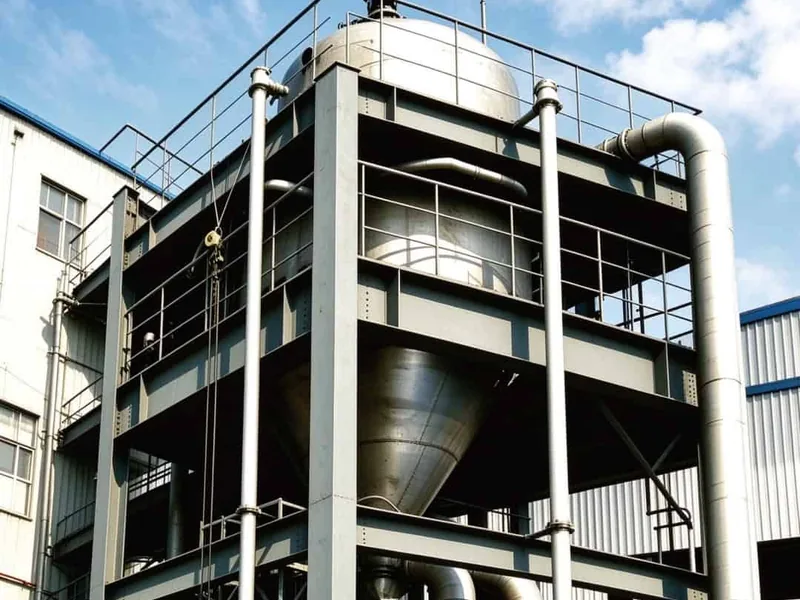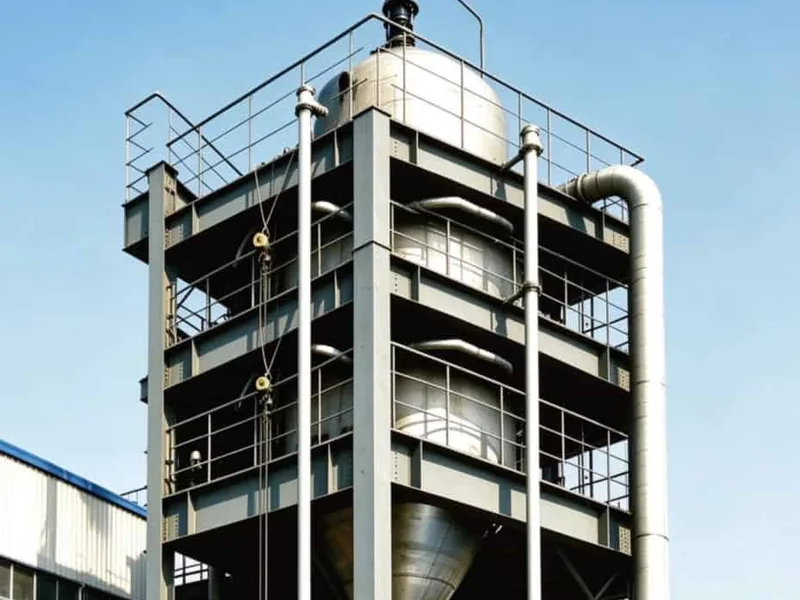
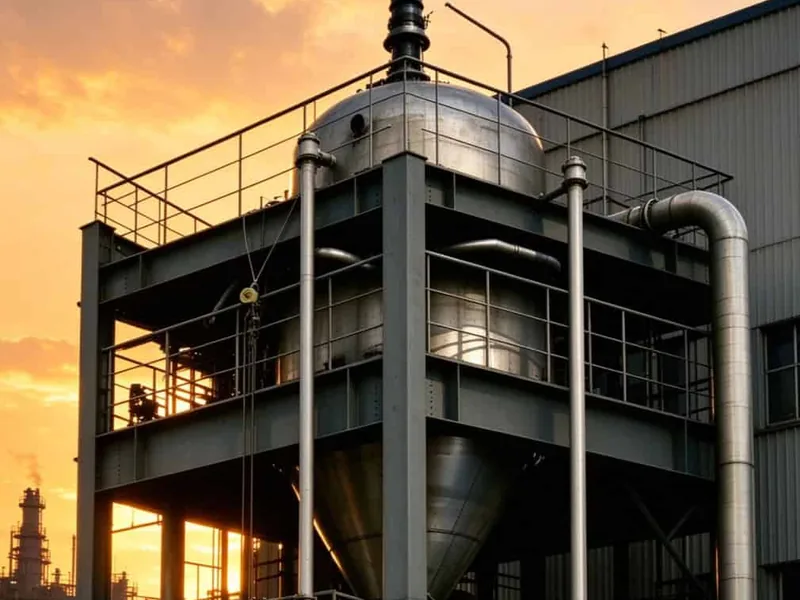
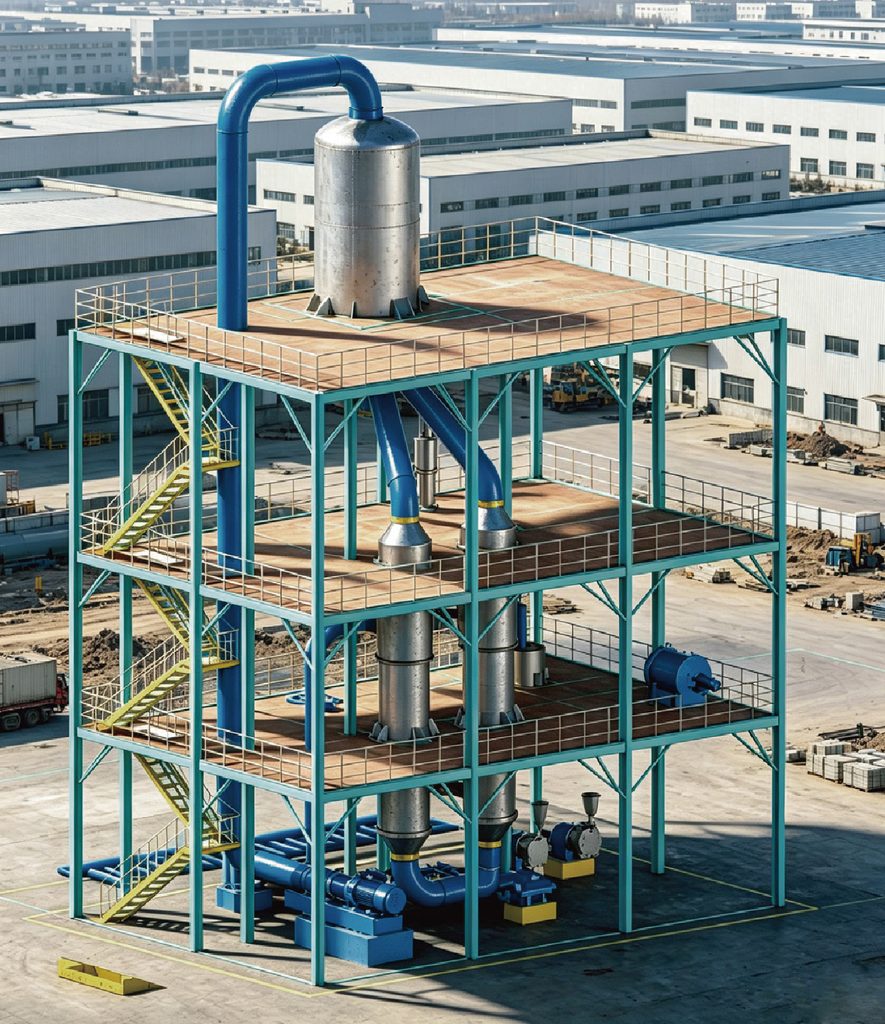
Multi-effect evaporation concentrates a solution by reusing its own vapour across a series of vessels at decreasing temperature. Instead of one heating surface doing all the work, several effects share it, and steam consumption falls in proportion to the number of stages. Center Enamel delivers Multi-Effect Evaporator System packages for chemical, food, pharmaceutical and wastewater concentration duties.
Multi-Effect Evaporation Explained
Feed enters the train and passes from effect to effect, either forward, backward or in parallel depending on the product’s viscosity and temperature sensitivity. Vapour from the first effect heats the second, vapour from the second heats the third, and so on until the terminal condenser. Each effect therefore operates at a lower temperature and a lower boiling point than the one before.
With three effects, roughly three kilograms of water evaporate per kilogram of steam; with five effects, roughly five. A Multi-Effect Evaporator System designed on that basis gives a plant a direct, measurable reduction in utility cost. The trade-off is additional vessels and a larger footprint, which is why the effect count is chosen against steam price, electricity price and available plot space.
Falling Film and Forced Circulation Configuration
Falling film bodies suit heat-sensitive products because the liquid spends only seconds on the heated surface and the residence time stays short. Forced circulation bodies handle viscous, scaling or crystallising solutions by keeping the liquor moving rapidly through the tubes. Many trains combine both types, using falling film for the early effects and forced circulation for the concentration end.
Center Enamel selects the tube geometry, circulation rate and separator design for each effect individually. Vapour velocity through the demister is set to prevent entrainment, and the liquid distributor above each bundle is machined so that every tube receives the same film. That attention to detail is what keeps a Multi-Effect Evaporator System stable at high concentration.
Crystallisation duties need a different arrangement again: a forced circulation crystalliser with a settling or filtration stage follows the evaporator when the product must leave as solid. That downstream step is coordinated with the evaporator discharge so that the solids load entering the separator stays within its design range.
Steam Economy and Energy Savings
Steam economy depends on effect count, boiling-point elevation and the efficiency of feed preheat. High dissolved solids raise the boiling point and reduce the usable temperature difference between effects, so the design must allow for that elevation rather than assume pure-water behaviour. Preheating the feed against condensate and against the product discharge recovers heat that would otherwise leave the plant.
Thermal or mechanical vapour recompression can be added to the train where the economics support it, lifting economy further. Center Enamel models these combinations against the customer’s utility tariffs and operating hours, so the delivered system is optimised for total cost rather than for a single performance figure.
Vapour pressure drop between effects also influences economy. Oversized piping costs little but reduces the usable temperature difference, while undersized piping forces the downstream effect to operate at a lower pressure. Center Enamel sizes interstage lines and demisters against the actual vapour flow so that the designed economy is reached in service.
Process Control and Product Consistency
Density at the discharge is the primary controlled variable. It drives the feed rate or the transfer between effects, while vacuum control at the terminal condenser stabilises the whole temperature cascade. Each effect carries its own level control so that the heating surface stays fully wetted without flooding the vapour space.
Interlocks protect the train during start-up and shutdown, and the sequence is documented for the plant’s control system. Center Enamel supplies the control philosophy, instrument schedule and alarm list with each package, which lets the automation team integrate the Multi-Effect Evaporator System into the plant’s architecture without additional process engineering.
Materials, Fabrication and Support
Materials follow the product chemistry: 304 or 316L stainless for food and pharmaceutical duties, duplex and titanium for chloride-bearing streams, and clad plate where aggressive liquors contact carbon steel shells. Tube-to-tubesheet joints are expanded and, where required, seal welded to hold tight through repeated thermal cycling.
Fabrication runs under an ASME-certified programme with material traceability, weld qualification, heat treatment and non-destructive examination. As a China Multi-Effect Evaporator System Manufacturer, Center Enamel provides installation supervision, commissioning support and spare bundles and pumps, so maintenance planning stays predictable over the plant’s life.
Why Choose Center Enamel
Center Enamel builds evaporator trains in house, from vessel fabrication to package assembly, on a 150,000 square metre production base. That integrated scope means a Multi-Effect Evaporator System arrives complete with its pumps, condensers, instrumentation and structural steel under one quality system.
Process industries choose Center Enamel for designs grounded in real product data, documentation that supports operation and maintenance, and delivery schedules that fit plant construction milestones. Each train is tested before shipment so that performance verification begins from a known baseline.