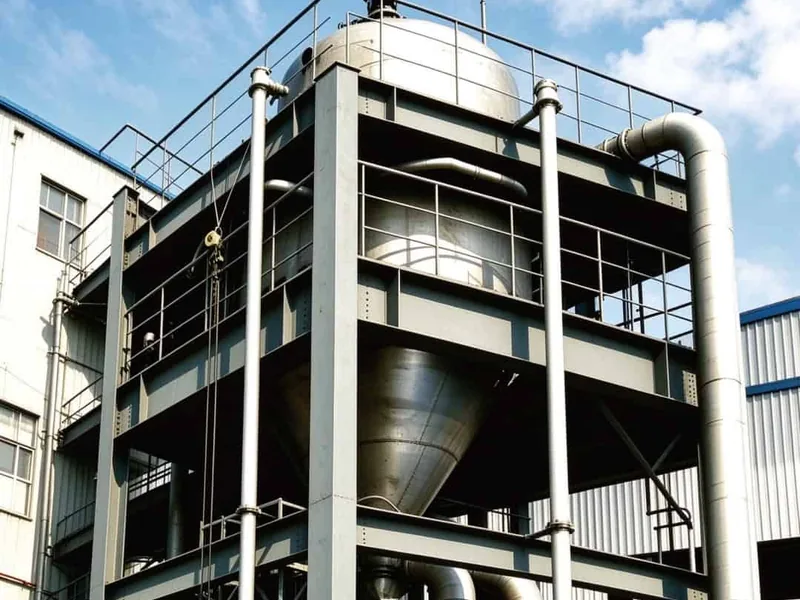
Reducing the pressure above a liquid lowers its boiling point, and that simple principle protects products that would degrade at atmospheric temperature. Vitamins, proteins, flavours, pharmaceutical intermediates and polymer solutions all benefit from evaporation carried out under vacuum. Center Enamel builds Vacuum Evaporator System packages for these low-temperature concentration duties.
Why Vacuum Evaporation Protects Heat-Sensitive Products
At reduced pressure, water boils at 40 to 60 degrees Celsius instead of 100, and many organic solvents boil well below their atmospheric points. The product therefore spends its residence time at a temperature that preserves structure, colour and activity, while the same evaporation rate is achieved with a smaller temperature difference across the heating surface.
A Vacuum Evaporator System also limits oxidation, because the vessel contains little oxygen during operation. For food ingredients and natural extracts, that combination of low temperature and low oxygen preserves aroma compounds and appearance far better than atmospheric boiling, and the difference is visible in the finished product specification.
System Layout and Vacuum Generation
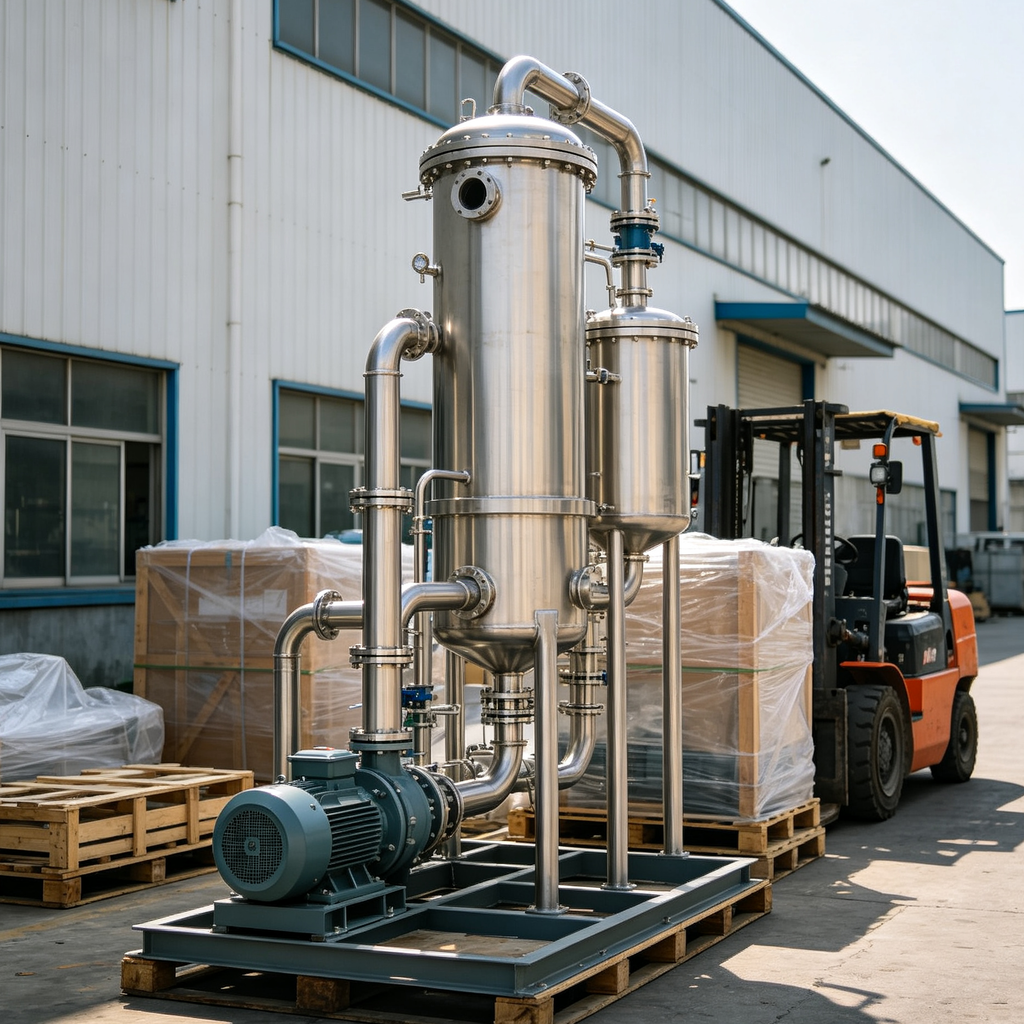
A complete package includes the evaporator body, separator, condenser, vacuum pump or ejector set, condensate receiver, feed and transfer pumps, and the interconnecting skid piping. The vacuum source is selected against the required operating pressure, the non-condensable load and the vapour quantity, since each type of pump performs differently across the pressure range.
Center Enamel assembles these components on a structural frame with tagged piping and verified electrical interfaces. Because the Vacuum Evaporator System arrives coordinated, the vacuum pump capacity, condenser area and vessel volume already align, and site work focuses on service connections rather than on matching mismatched equipment.
Heat Transfer at Low Temperature
Low boiling temperature means a small temperature difference between the heating medium and the product, so the heating surface must be generous relative to the duty. Falling film bundles, plate packs and wiped or agitated bodies each provide a different answer: falling film gives short residence and good coefficients at modest viscosity, while wiped bodies handle very high viscosity and fouling products.
Circulation and distribution details matter more under vacuum, because the low absolute pressure amplifies the effect of any dissolved gas or slight leak. Center Enamel specifies deaeration at the feed, venting at the condenser and distributor designs that wet every tube, so the delivered Vacuum Evaporator System holds its coefficient instead of losing performance to blanked surface.
Control and Product Quality
Vacuum level, heating medium temperature and feed rate form the operating triangle. Density or refractive index at the discharge closes the loop, and the control scheme modulates feed to hold the concentration set point. Because the boiling point follows the vacuum, pressure control effectively becomes temperature control, which allows tight thermal limits to be maintained.
Center Enamel supplies the control philosophy, alarm schedule and interlock description with each package, along with sampling points that let the lab confirm quality against the batch record. Operator training during commissioning covers start-up sequencing under vacuum, which is where most product-quality deviations originate.
Applications Across Sensitive-Product Industries
Food and beverage plants use vacuum evaporation for fruit juice, dairy concentrate, coffee and flavour recovery. Pharmaceutical manufacturers concentrate extracts and intermediates where thermal exposure must be minimal. Chemical plants apply the same principle to heat-sensitive resins, surfactants and recovered solvents, and environmental facilities use it to concentrate leachate and effluent.
Materials follow the duty: 316L stainless and duplex grades for food and pharmaceutical service, titanium for chloride-bearing streams, and clad plate where carbon steel shells meet aggressive liquors. Surface finish and cleanability are specified for products where residue or microbial growth is a consideration.
CIP and drain design are part of the same package. Spray balls, a low-point drain and a rinse circuit allow cleaning without opening the vessel, which matters because breaking vacuum for manual cleaning costs a full day of production. Where the product is pharmaceutical, the cleaning procedure is documented step by step for validation.
Fabrication, Installation and Support
Fabrication follows an ASME-certified programme with material traceability, weld qualification, heat treatment and non-destructive examination. Vacuum vessels are leak-tested before shipment, because a small leak discovered on site costs far more than one corrected in the shop.
As a China Vacuum Evaporator System Manufacturer, Center Enamel provides installation supervision, commissioning and operator training, and supplies spare bundles, seals and vacuum pump components. Inspection intervals and cleaning procedures are documented at handover, so the Vacuum Evaporator System keeps its performance through long production campaigns.
Why Choose Center Enamel
Center Enamel designs, fabricates and assembles vacuum evaporator packages in house on a 150,000 square metre production base, covering carbon steel, stainless steel and clad construction. Each package arrives complete with its vacuum set, condenser and control panel under one quality system.
Producers of heat-sensitive products choose Center Enamel for designs grounded in their material data, documentation that supports operation and maintenance, and dependable delivery. Every unit is tested before shipment so that performance verification starts from a known baseline.