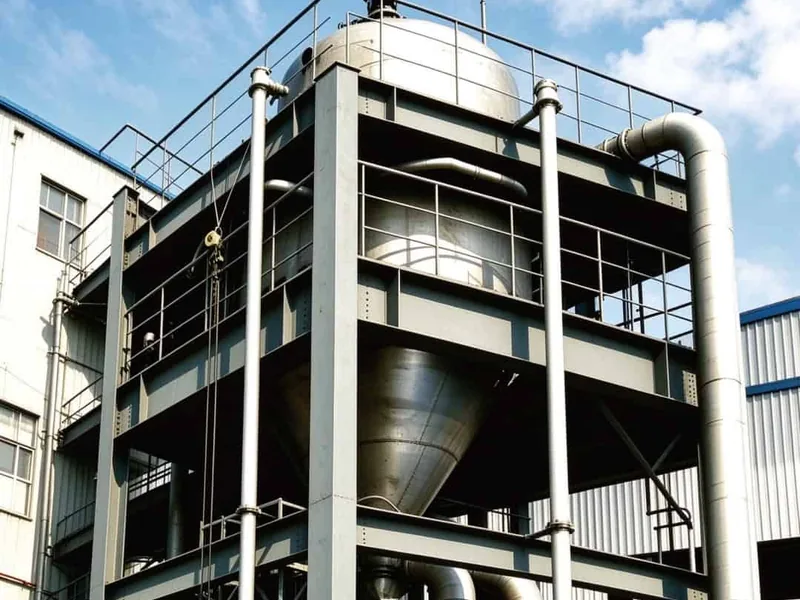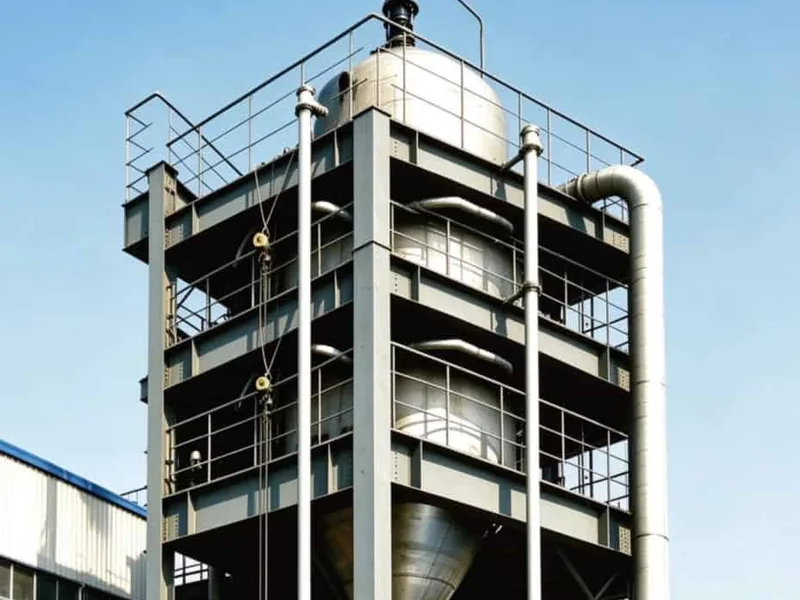
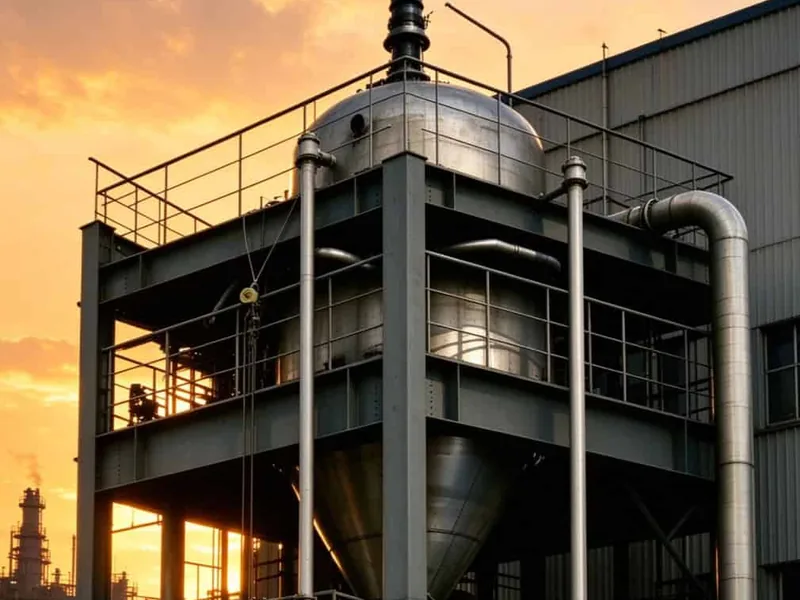
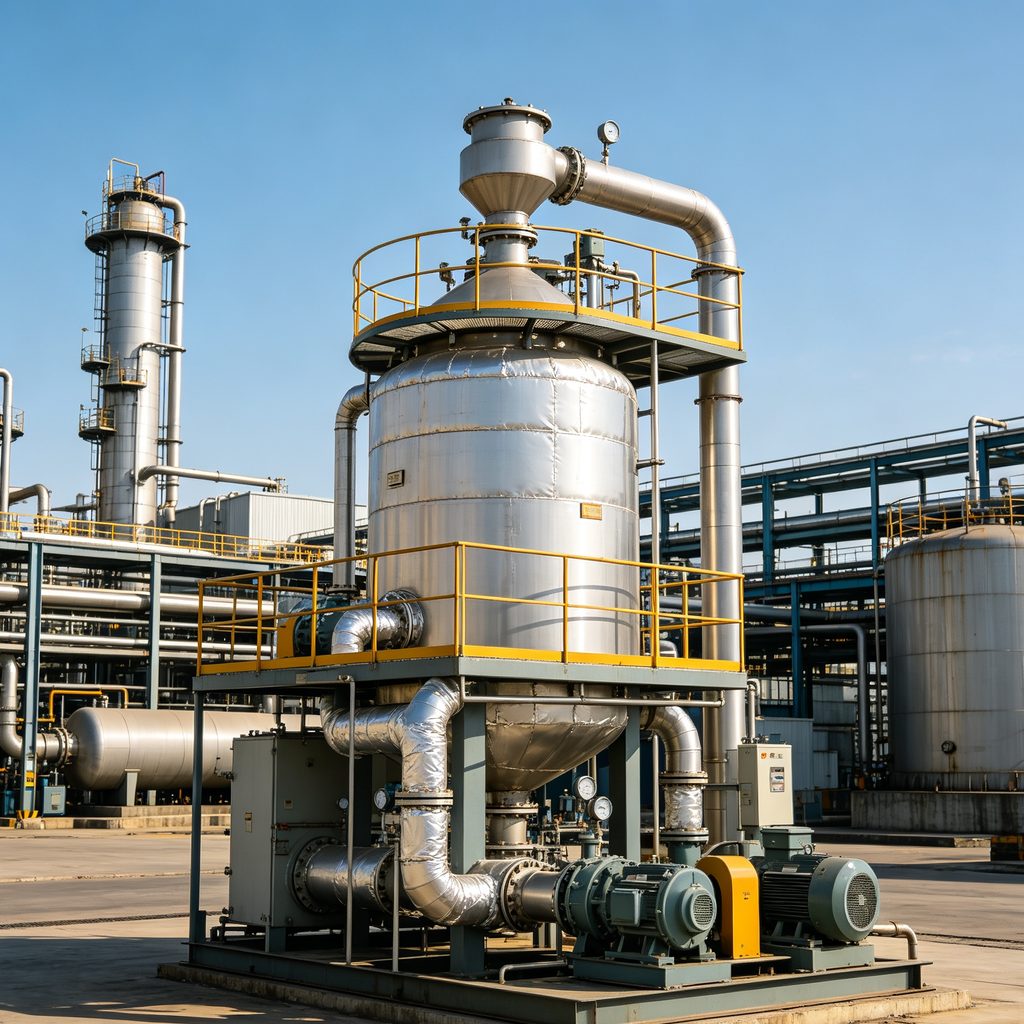
Mechanical vapour recompression turns the vapour an evaporator produces back into its own heating source. A compressor raises the vapour temperature slightly, and the recompressed vapour condenses on the heating surface to boil more liquid. The result is an evaporator that runs on electricity instead of steam, with very little external heat input. Center Enamel builds MVR Evaporator System packages for concentration and water recovery duties.
Mechanical Vapour Recompression in Practice
The evaporator boils liquid under vacuum, and the vapour is drawn into a centrifugal or roots-type compressor. Compression raises both temperature and saturation point, so the discharge vapour condenses at a temperature above the boiling liquid and releases latent heat into the heating bundle. Condensate leaves as high-quality water, and the concentrated product discharges from the sump.
Because the latent heat is recycled internally, the system’s main energy input is compressor power. A well-matched MVR Evaporator System reduces steam consumption to a fraction of what a single-effect unit would need, and it does so without the boiler capacity, condensate handling and cooling water load that steam-driven trains require.
System Components and Configuration
A complete package includes the evaporator body, vapour separator, compressor, condenser or vent circuit, feed and circulating pumps, heat exchangers for preheat and cooling, and the electrical and control cabinet. The compressor selection depends on volumetric flow, required temperature lift and the specific volume of the vapour at the operating point.
Center Enamel assembles these elements on a common skid with tagged piping and verified electrical interfaces. Because the MVR Evaporator System is coordinated as one package, compressor curves, separator dimensions and bundle surface area all align with the duty, and site work is limited to foundations and service connections.
Steam Consumption and Operating Cost
The economic case for mechanical recompression rests on the ratio between electricity and steam prices, and on the temperature lift the process requires. Small lifts favour MVR strongly; large lifts increase compressor power and may justify a hybrid arrangement with a steam-driven first effect. Feed preheat against condensate and product reduces the lift further and improves the return.
Center Enamel models each case against the customer’s utility tariffs, operating hours and product characteristics before proposing a configuration. That analysis is why the delivered system usually meets its cost target in practice rather than only on paper, and why operating teams find the load-following behaviour predictable.
When the lift is large or the vapour contains condensable organics, a hybrid arrangement pairs a steam-driven first effect with mechanical recompression on the remainder. This keeps compressor power within a sensible range while still cutting overall steam demand, and it gives operators a fallback mode if electricity pricing changes.
Water Recovery and Concentrate Handling
Recovered condensate from an MVR unit is typically clean enough for reuse as boiler feed, process water or wash water, which turns a disposal problem into a resource. Conductivity monitoring on the condensate line confirms quality before it enters the recovery circuit, and a diversion valve protects the system if a carry-over event occurs.
Concentrate discharge is controlled by density, and crystalliser or spray-dryer sections can be added where the duty moves toward zero liquid discharge. Center Enamel coordinates the concentrator with those downstream steps, so the MVR Evaporator System delivers a consistent solids load rather than a variable one that destabilises the next stage.
Control and Automation
Compressor speed, feed rate and product density form the core control loop. Vapour temperature and pressure across the compressor define the lift, and the control scheme holds that lift steady as feed conditions change. Anti-surge protection, bearing monitoring and vibration trending are built into the compressor control logic.
Instrumentation is wired to a PLC-based panel with a clear operating interface, and the package is delivered with control narratives, cause-and-effect tables and alarm schedules. That documentation lets the plant integrate the MVR Evaporator System into its own distributed control architecture and train operators against a defined sequence.
Materials, Fabrication and Service
Wetted materials follow the chemistry of the stream: 316L stainless for many duties, duplex and titanium for chloride-bearing liquors, and clad plate where carbon steel shells contact aggressive media. Compressor impellers and casings are selected for the vapour composition, which may include organic carry-over or traces of acid gases.
Fabrication follows an ASME-certified programme with material certificates, qualified welds and non-destructive examination. As a China MVR Evaporator System Manufacturer, Center Enamel supports installation, commissioning and operator training, and supplies spare bundles, mechanical seals and instrumentation so that maintenance does not depend on imported long-lead parts.
Why Choose Center Enamel
Center Enamel designs, fabricates and assembles MVR packages in house on a 150,000 square metre production base covering carbon steel, stainless and clad materials. A MVR Evaporator System can therefore be delivered complete, from evaporator body to control cabinet, under one quality system.
Plants pursuing energy savings and water reuse choose Center Enamel for designs grounded in their actual duty, documentation that supports operation and clear delivery milestones. Each package is tested before shipment, so performance verification starts from a documented baseline.